Results
What the flight showed
Preliminary results from the CAN-RGX 2026 parabolic flight campaign, first presented at the 77th International Astronautical Congress in Antalya, Türkiye.
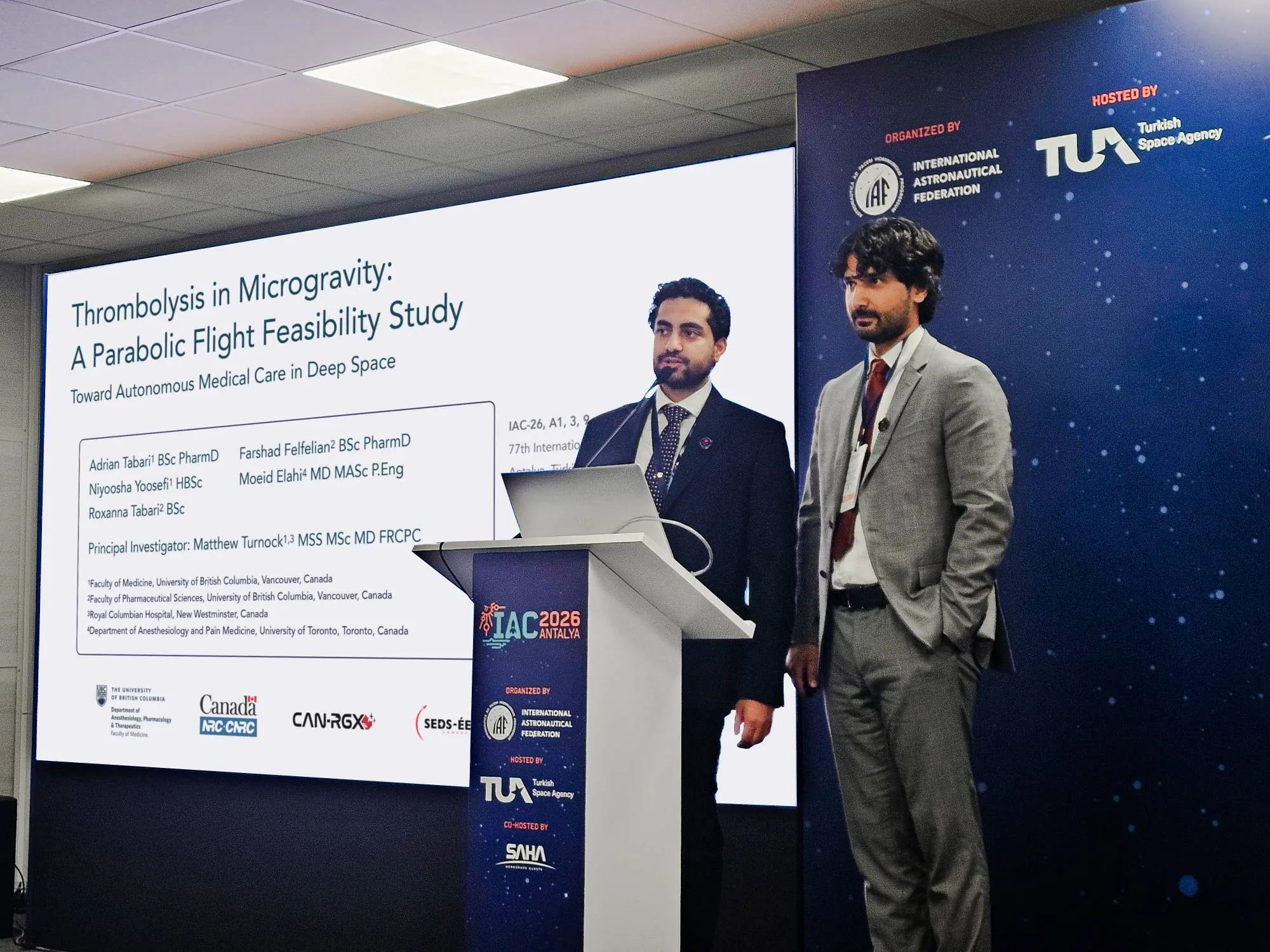
77th International Astronautical Congress
Thrombolysis in Microgravity: A Parabolic Flight Feasibility Study Toward Autonomous Medical Care in Deep Space
An oral presentation of the platform, the flight and the first look at the data. The paper appears in the congress programme as Thrombolytic Pharmacodynamics in Microgravity: Implications for Autonomous Medical Care in Deep Space.
- Paper
- IAC-26,A1,3,9,x113307
- Session
- 6 October 2026 · Hall 7
- Location
- Antalya, Türkiye
The flight
Two days on the NRC Falcon 20
CLOT-LESS flew out of Ottawa on 1 and 2 September 2026: nine parabolas on the first day and eleven on the second. The first day did not produce usable data, so everything below comes from the second, logged by the payload's own accelerometers and pressure sensors at 20 Hz.
-
2
Flight days
1–2 September 2026
-
11
Parabolas analysed
Flight day 2 · 10 paired runs
-
22 s
Microgravity window
Per parabola, measured
-
0.07 g
Mean residual gravity
From onboard accelerometers
How each run worked
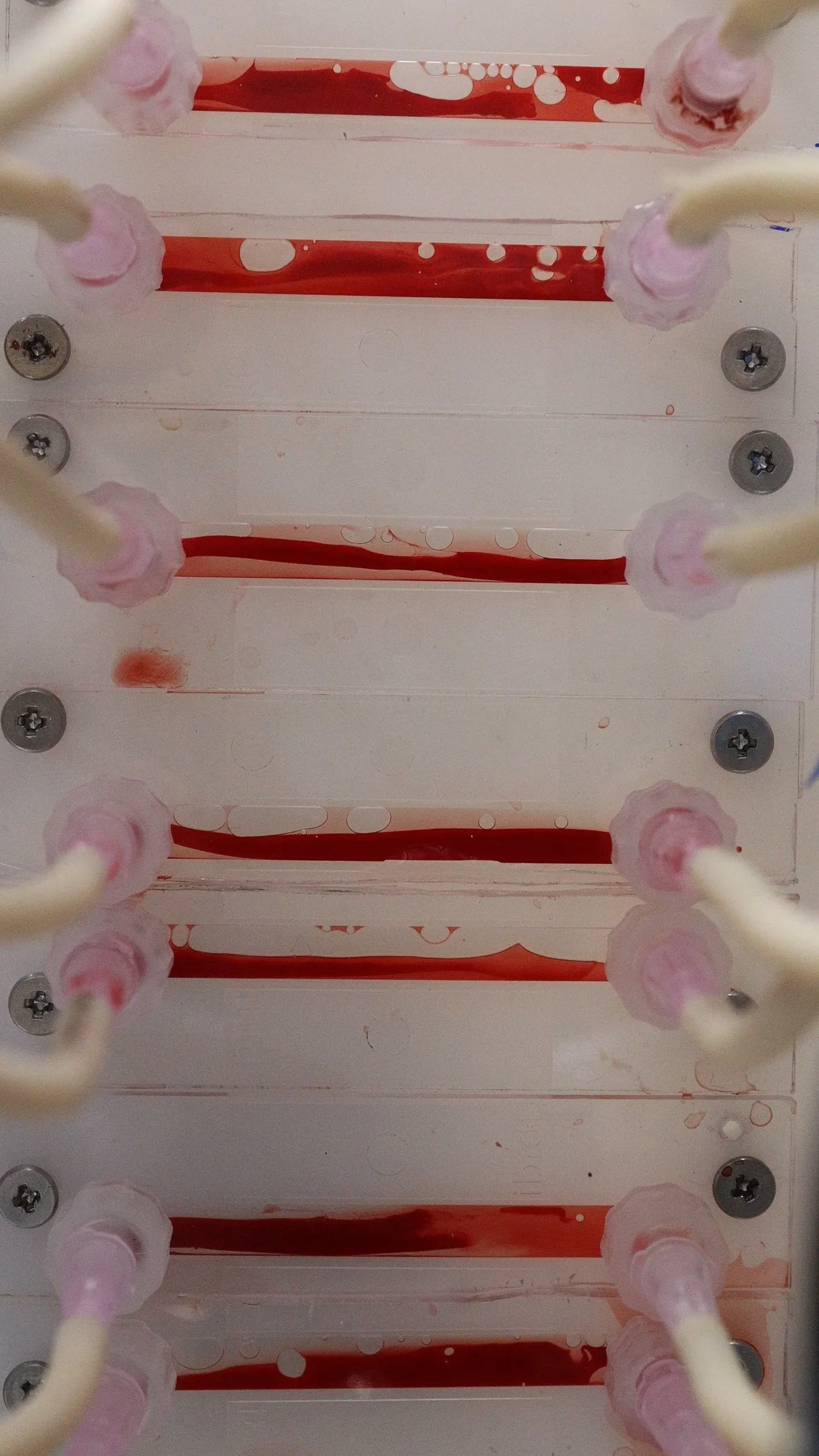
The design is paired: on every parabola one tenecteplase (TNKase) channel and one saline channel were infused at the same time, through clots made from the same blood. Each clot pair was then infused again on the next two parabolas, to follow how its resistance changed with repeated exposure.
Each run started at zero-g onset with a short take-up phase, then infused at 150 µL/min for the rest of the microgravity window, while the pressure drop across the clot, the gravity level and video were recorded throughout. A clot blocking the channel raises the pressure needed to push fluid through it; as it dissolves or erodes, that pressure drop falls.
On the second flight day the platform worked as designed: runs started right at zero-g onset and the system logged the whole flight with no data loss.
Main result
What we saw
With every repeat infusion, the clots treated with tenecteplase became noticeably easier to push fluid through, potentially signalling that they were breaking down. The matching saline controls barely changed, although due to our limited number of samples, statistical significance cannot be established.
-
TNKase channels
Clearly loosened
In all three clot pairs, resistance to flow fell with each infusion of the drug.
-
Saline controls
Barely changed
The same clots perfused with saline stayed close to where they started.
The difference held in the same direction in every pair, even after correcting for small offsets in the sensors' baselines. That is the pattern you would expect if a clot-dissolving drug keeps working in microgravity.
We cannot yet tell how much of the change is the drug dissolving the clot versus fluid physically wearing it away. Full results will follow in a peer-reviewed paper.
Lessons
What the flight taught us
- 01
Fresh clots are stiffer than expected
The first push into a new clot went past the range of our pressure sensors. By the second infusion the clot had loosened enough to read normally.
- 02
22 seconds is enough
The pressure reading settles within a few seconds of the pump starting, leaving most of each parabola as steady, usable signal.
- 03
Vomiting is inevitable
Don’t resist.
Conclusions
Where this leaves us
- Platform
- An automated, paired pressure-drop platform measured thrombolysis on every parabola.
- Pharmacology
- Clot resistance fell noticeably over repeat TNKase infusions and only slightly with saline, in all three pairs.
- Limitations
- Only three clot pairs, and the clots were not size-matched. We cannot yet separate enzymatic lysis from mechanical erosion, and the 1 g comparison is limited to one run.
Next steps
- 01 Wider-range sensing
Pressure sensors with a wider range, to capture the first push into fresh clots instead of saturating.
- 02 D-dimer sampling
D-dimer in the effluent as a biochemical marker of fibrin breakdown, alongside the pressure read-out.
- 03 Glass slides
Glass channels for better clot adherence to the walls.
Beyond thrombolysis: the same platform can test other hematologic questions in microgravity — anticoagulants, platelets and hemostatic agents.
How the platform was built → Photos from the flight and the congress →